
Pakistan abolishes license requirement for solar users up to 25kW
May 8, 2026
To meet power shortfall Pakistan moves towards sustainable energy
May 22, 2026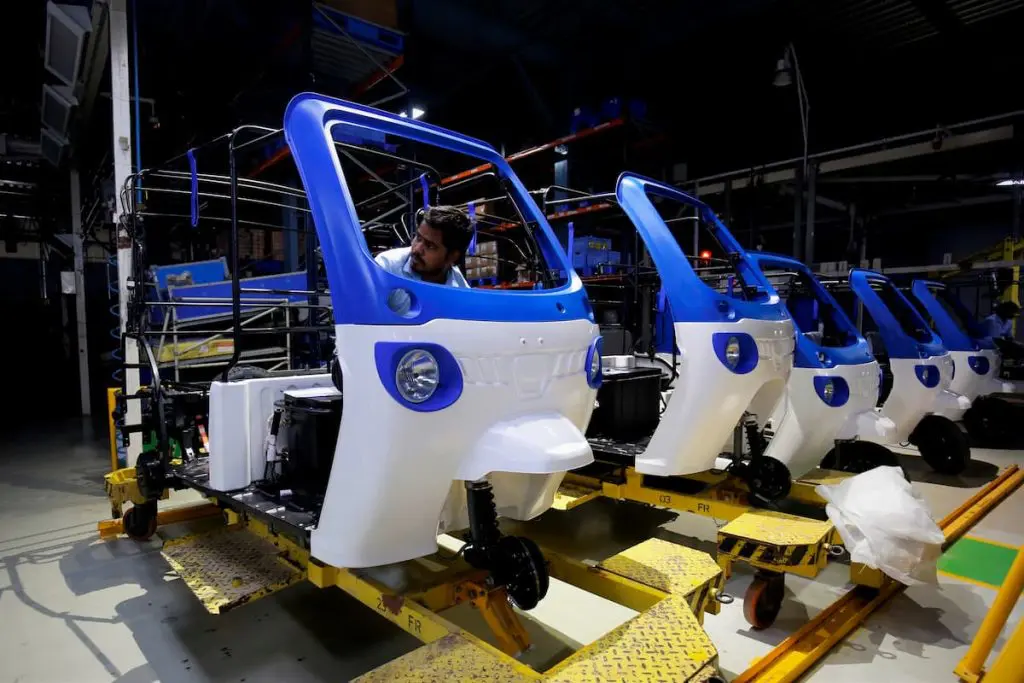
Pakistan is set to avoid the worst of the fuel price rises from the Strait of Hormuz closure, thanks to its quiet solar revolution.
Electric rickshaws being constructed on a production line. Pakistan is not immune to fuel price shocks, but its solar capacity may help dampen the effects. Photo: Abhishek Chinnappa / Climate Visuals Countdown
Key points
The rapid expansion of solar power in Pakistan, spurred by the 2022 energy crisis, has paid off, saving the billions in oil and liquified natural gas imports since 2020 and providing relief from spiralling electricity costs. This has also significantly reduced vulnerability to supply disruptions with the Strait of Hormuz closure.
Despite the success of solar, Pakistan’s rigid, long-term “take-or-pay” LNG contracts have become a liability, contributing to a supply glut and costing the country $378mn in annual losses. This reveals “an energy procurement strategy misaligned with the country’s evolving demand and the accelerating development of renewable energy”, according to one energy analyst.
While Pakistan reduces its reliance on fuel imports, other Asian economies remain exposed to fossil fuel volatility and are turning to costlier, high-emission options like coal. Experts estimate that adopting renewables like solar could meet the region’s new power needs at half the cost of gas, saving up to $67bn.
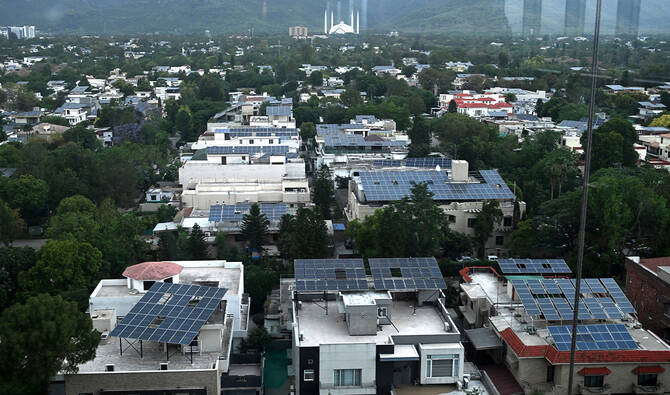
Pakistan, which was severely hit by the 2022 energy crisis following Russia’s invasion of Ukraine, has quietly expanded its distributed solar capacity in the years that followed.
As the world faces the second major energy crisis in four years, sparked by US-Israel’s war on Iran, early signs show that the country’s bet on solar has paid off.
An analysis by Islamabad-based Renewables First and the Centre for Research on Energy and Clean Air (Crea) finds that since 2020, Pakistan has avoided over US$12bn in oil and gas imports that it would have otherwise have needed to meet domestic energy needs, due to its community-led solar boom. It could save a further $6.3bn by the end of this year if energy prices remain elevated.
Much of Pakistan’s imported liquified natural gas (LNG) and oil continue to be shipped through the Strait of Hormuz, a strategic waterway where traffic has come to a virtual standstill since the war began.
As a result, Pakistan – which relies almost entirely on Qatar and the United Arab Emirates for its LNG imports – has not been immune to the latest price shocks despite rooftop solar climbing up from near-zero levels to make up a quarter of the country’s energy mix in the past decade.
Consumer prices for diesel and petrol have surged by about 20% due to the conflict in Iran. To manage energy shortages, the government has introduced a four-day work week and temporarily suspended LNG supplies to its fertiliser plants.
However, Nabiya Imran, energy insights associate from Renewables First said in a media briefing that “the impact would have been far worse had people not been adopting solar”. Since energy needs in the daytime are increasingly being met by solar, LNG is primarily used to meet nighttime demand, she added.
In fact, Pakistan’s high levels of distributed solar and reduced reliance on grid power is precisely what has enabled working from home during this period as a viable and affordable option, acting as a buffer against supply disruptions and price shocks, say the report’s authors.
“The fact that load shedding and other measures to restrict power supply during peak demand periods are not currently being considered shows how solar is both saving money and providing additional power,” they write.
Affordability concerns were the key catalyst for Pakistan’s unprecedented solar boom, starting with businesses and households who could afford the upfront costs of buying China-made panels to generate their own power more cheaply and reliably. Eventually, poorer communities started pooling together funds to put up panels on the roofs and backyards of farms, orphanages, mosques and medical clinics.
Demand surged so much that in 2024, Pakistan ranked fourth in the world after the US, India and Brazil for imported panels.
“The grassroots solar surge has gathered pace since the energy crisis of 2022 and has quietly delivered what years of state energy policy had not thus far: falling fuel import dependence, stronger energy security and a measure of relief from spiralling electricity costs for millions of households,” the authors state.
LNG imports becoming an economic liability
Unlike in 2022, when Pakistan saw its LNG cargoes being diverted to more profitable markets in Europe, it is now suffering from excess fuel imports, contributing to a supply glut.
The glut – a result of weakening consumer demand, rapid solarisation and uncompetitive prices arising from rigid contractual obligations – has cost Pakistan $378mn in annual losses as it curbs local production and sells its gas to domestic industries at steep discounts.
To limit some of these losses, it is looking to offload excess LNG in international markets. Even before the latest energy crisis, Pakistan was planning to renegotiate its long-term supply agreements with Qatar and Italian gas producer Eni for the reselling of 45 excess LNG cargoes. The net proceed differential (NPD) clause in its Qatari contracts, however, means that any profit from the sale of these excess cargoes is retained by Qatar, while Pakistan is left to incur the entirety of the loss if they are sold below the fixed contracted price.
“The rigid, long-term take-or-pay contracts, once valued for energy security, have become a financial burden in a market that prioritises flexibility and low-cost generation,” writes Haneea Isaad, a Pakistan-based energy finance specialist at the Institute for Energy Economics and Financial Analysis in a recent note.
“Renegotiating contracts to offload excess LNG cargoes may provide immediate, if costly, relief, but does not address the root cause – an energy procurement strategy misaligned with the country’s evolving demand and the accelerating development of renewable energy.”
Regional peers remain exposed to volatility
While Pakistan has reduced its import reliance in recent years, the story is markedly different for the country’s regional peers, such as China, India, South Korea and most other south-east Asia economies, which have continued to expand their LNG imports.
“Although Pakistan still appears prominently in both the volume and dependency rankings for Hormuz-transiting energy, the trajectory is downward,” say Renewables First and Crea.
“This trajectory is not the same in the wider Asian region, which is disproportionately exposed. It accounts for the majority of Hormuz-dependent oil and LNG flows, and any sustained disruption would continue to hit Asian economies hardest.”
The Gulf conflict is leading some of these highly-exposed markets to consider turning to fossil fuels such as coal to meet energy demand.
India and China are turning to their domestic coal stockpiles, while Indonesia – the world’s top coal supplier – has allowed miners to boost output. South Korea has lifted its limits on coal plant utilisation, with Japan, Thailand, the Philippines and Vietnam looking to follow suit.
A separate report by Ember, however, warns that while the average levelised cost for coal – which current stands at about $76 per megawatt hour (MWh) – is less than the $104/MWh gas generation costs, it remains a costlier fallback option, both economically and environmentally, compared to renewables.
Additionally, the thinktank estimates that solar could meet the region’s new power needs at half the cost of gas, saving the region up to $67bn.
“Developing and emerging economies in Asia will be at higher risk if energy prices continue to escalate. While energy saving can be an initial short-term solution, the pivot to homegrown renewables can provide more options to buffer future energy shocks,” says Dinita Setyawati, Ember’s senior Asia energy analyst.
While most of south-east Asia remains relatively insulated from immediate price shocks, energy security concerns are likely to accelerate structural shifts to nuclear power and wind and solar with battery storage, according to a recent note from industrial consultants Wood Mackenzie.
“Sustained volatility in global energy markets is likely to sharpen the region’s focus on energy security, accelerating investment in nuclear and firmed renewable capacity as alternatives to gas-fired generation,” states Yanqi Cao, senior analyst for Asia Pacific power and renewable research at Woodmac.
Update, 10 April: this story was amended to clarify that the Gulf crisis is causing highly exposed countries to turn to coal, not coal and gas as previously stated.